Since the
Mapua Makers Market (which was on 9 Feb) I've been beavering away on another deadline - my entries for this years
Changing Threads National Contemporary Fibre Awards. I have entered this award three times and been chosen twice, both with blanket wall hangings. As I blogged about last year
here.
This year I've stepped away from wool and felt into the great unknown - environmental art! Tomorrow I drop my entry into the gallery on CD, so I've been taking photos and writing my artist statement and going slightly crazy. But hey even if I don't get one or two pieces selected at least I can share it with the my lovely readers on this blog.
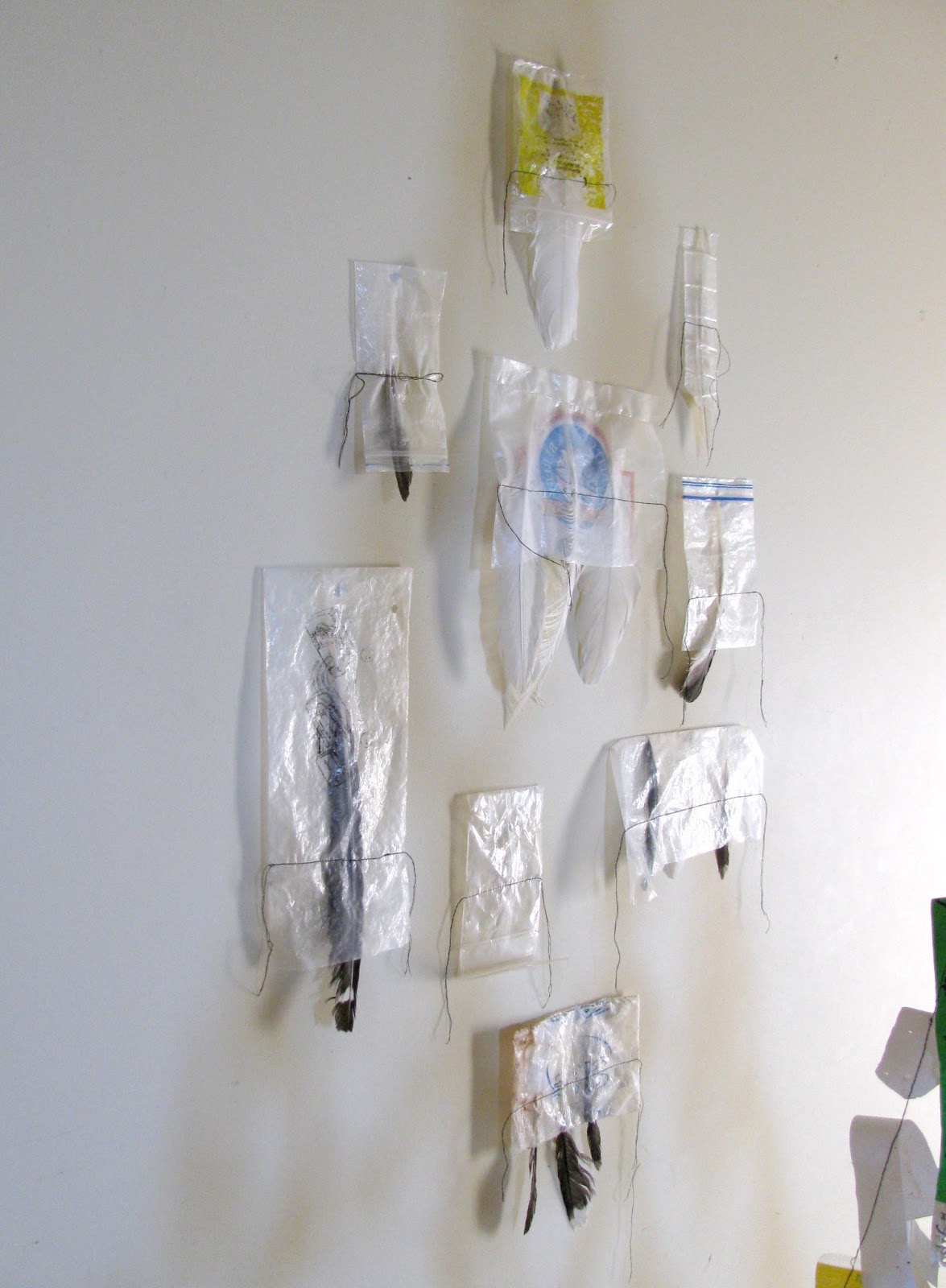
The first piece I created is an installation, so is quite hard to photograph especially in my garage. It's titled "Coming Home to Roost", and my statement about it is:
This installation is constructed from
some of the plastics that I have collected from the beach at Ruby Bay over the
last 18 months. Some of the sources of this rubbish can easily be identified,
such as the tags off fishing vessels or parking meter tickets, which have flown
out of car windows. While these may look like paper they are in fact plastics,
the recycling symbol on the back of the parking meter tickets identifies these
as polypropylene.
It is hard to imagine the size of this
problem. In the North Pacific Ocean there is what is known as the Great Pacific
Garbage Patch, an estimated 11 million tons (and growing) of floating plastic
covering an area of nearly 5 million square miles of ocean, swirling in the Pacific
Ocean between the coast of California and Hawaii.
Unlike organic debris, which biodegrades,
plastics disintegrate into smaller and smaller pieces while still remaining a
polymer. They never “vanish” so throughout the decay cycle different sized organisms
are affected.
“Coming Home to Roost” is my response to
this disaster that we cannot see. While I realise that the amount of rubbish
that I pick up is so miniscule in the big picture, it may still help at the
individual level. If one bird is saved by my actions that is better than
walking past and leaving the rubbish to re-float in the next high tide, and go
who knows where?
In the centre of the shelter is a nest I made from fishing rope and twine. I made the top part first, and then added the mound, similar to what some sea birds build. This nest building led me onto using some of the large pile of twine and fishing line I've collected, and I made three vessels loosely based on a basket design. These are sewn together with salvaged fishing line which I had to untangle first.
The second entry is titled "Adrift".
These three vessels have been made using
pieces of fishing net, twine and line that I have collected while walking along
the beach at Ruby Bay. Originally the materials were used for fishing, and then
discarded, cut loose or lost to become part of the garbage system that drifts
with the ocean currents.
When fishing nets are left or lost by
fishermen they are known as ‘ghost nets’ which drift about continuing to do
what they were designed to; catching fish along with sea mammals, reptiles and
birds.
By piecing together the fragments I have
collected, I have made these vessels as a reminder of how fragile the marine environment
is, and the need to care for it.
This morning when I went for my daily look at what's happening in the world according to Facebook, I came across
Kirsty Elson's post with a link to this
video. It's mindblowingly sad, and makes me feel like every little bit of plastic that I pick up off the beach is making a difference. Take the time to watch it, please.